Asks the right questions. Works with you to develop the strategy, define the scenarios, and choose the analysis modules that match the client story. Then it builds the whole thing out: a presentation-ready client strategy, done.
60 seconds of conversation turns into a multi-scenario wealth plan your client can explore on their phone. Backed by 7 named AI agents, 20 analysis modules, and math your client can verify in real time.
Built for the mortgage advisor who refuses to compete on price.
Every model is graded against the model it replaced. Every prompt is cached. Every claim below points to a specific edge function and a specific eval file in the repo.
Asks the right questions. Works with you to develop the strategy, define the scenarios, and choose the analysis modules that match the client story. Then it builds the whole thing out: a presentation-ready client strategy, done.
Reads the scenario. Reads the chart you are looking at. When it tells you to click something, the actual button on screen pulses blue. No tab-switching to find the right setting.
Pulls the client story from the Strategy Dossier the Architect wrote. Pulls the active charts from the canvas. Hands you a script that addresses the client's exact objections.
Knows the scenario. Knows the math. Knows what the client asked yesterday at 11pm. Auto-flags hot intent so you know who to call back first thing in the morning.
Reads the scenario. Reads who the client is. Writes the first thing they will see on the share link. Confident, peer-to-peer, never marketing-speak. Never tells the client to "click the link" because they are already on it.
Searches Fannie, Freddie, FHA, VA, USDA. Returns yes or no answers with the section number you would quote to the underwriter. Architect calls Gary automatically when a scenario triggers a complexity marker.
Cross-references RentCast property data against Zillow, Redfin, Realtor.com. Returns price, taxes, insurance, HOA. 7-day cache. USPS-normalized. Saves the advisor ten minutes of manual lookup per scenario.
Type what the client just said, or tap one of fifteen common objections. The screen returns a verbatim line to read, three short bullets on why it works, an open-ended question to hand back, and pre-loaded one-liners for the two most likely comebacks. Voice modeled on the Loan Atlas teaching tradition. Sanitized of forbidden phrasing before it hits the screen.
The Architect writes a Strategy Dossier into a shared context table. Co-Pilot reads it. When a scenario gets complicated, Architect fires a non-blocking call to Guideline Gary and folds the handbook citation into the same answer. LensGuide pulses the actual UI element when an advisor asks for help.
graph LR
A["Architect
strategy-architect-v3"]
G["Guideline Gary
guideline-gary"]
SD[("Strategy Dossier
shared_agent_context")]
CP["Co-Pilot
analyze-strategy"]
PL["Property Lookup
property-search"]
SC["Scenario Card"]
CC["Client-Chat
client-chat-v3"]
LG["LensGuide
lens-guide"]
UI["Live UI
data-lens-id elements"]
A -->|"P2P, non-blocking"| G
A -->|"writes case file"| SD
SD -->|"reads on every turn"| CP
PL -->|"populates fields"| SC
SC -->|"feeds scenario context"| CC
LG -->|"pulses element"| UI
classDef agent fill:#1e293b,stroke:#3b82f6,color:#e2e8f0
classDef store fill:#0f172a,stroke:#8b5cf6,color:#e2e8f0
classDef ui fill:#0f172a,stroke:#10b981,color:#e2e8f0
class A,G,CP,PL,CC,LG agent
class SD,SC store
class UI ui
Source: AI_SYSTEM_MAP §11. Edges shown are documented P2P invocations and shared-context reads.
Each module answers a specific objection. Each module recalculates instantly when the client adjusts a number in the sandbox. Every chart is a closing argument the client can verify.
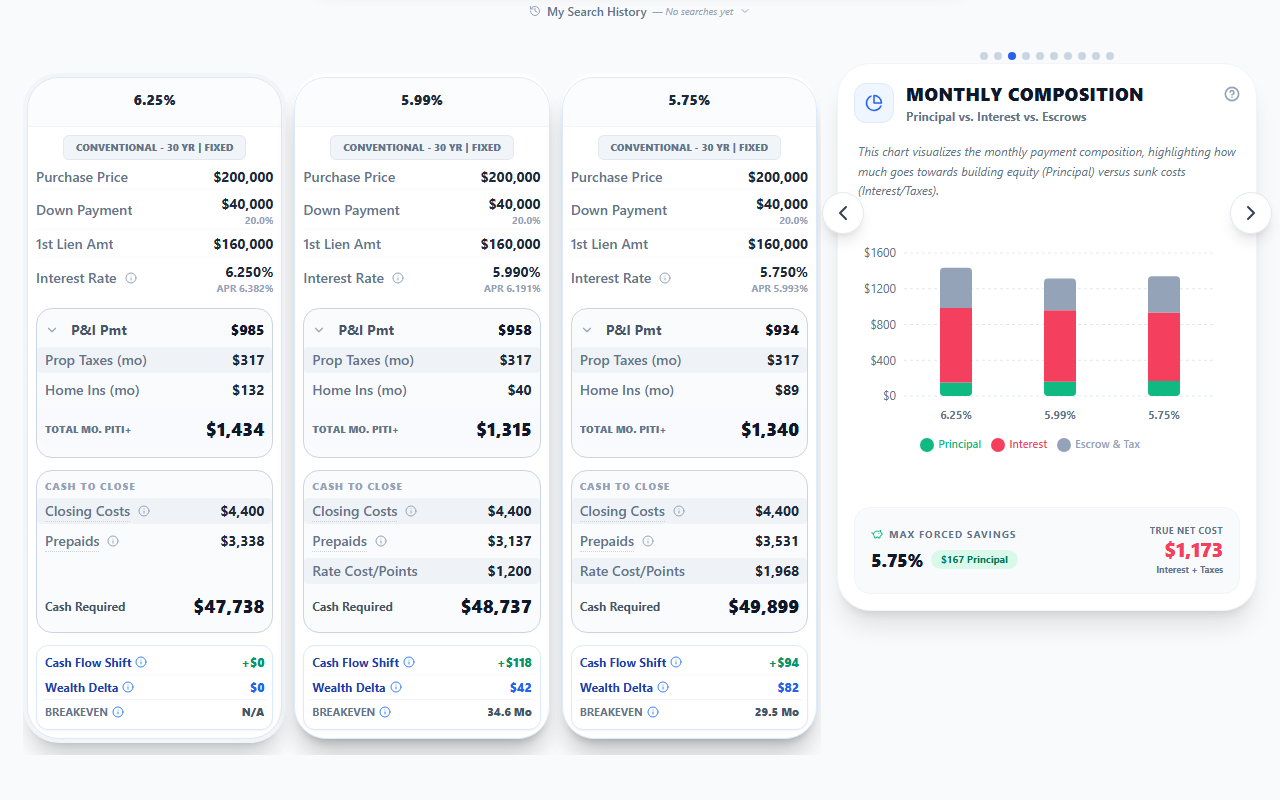
Where every dollar of the payment goes. Principal builds equity. Interest, taxes, insurance, MI sit in their own lanes so the client sees the mortgage as a strategy, not an expense.
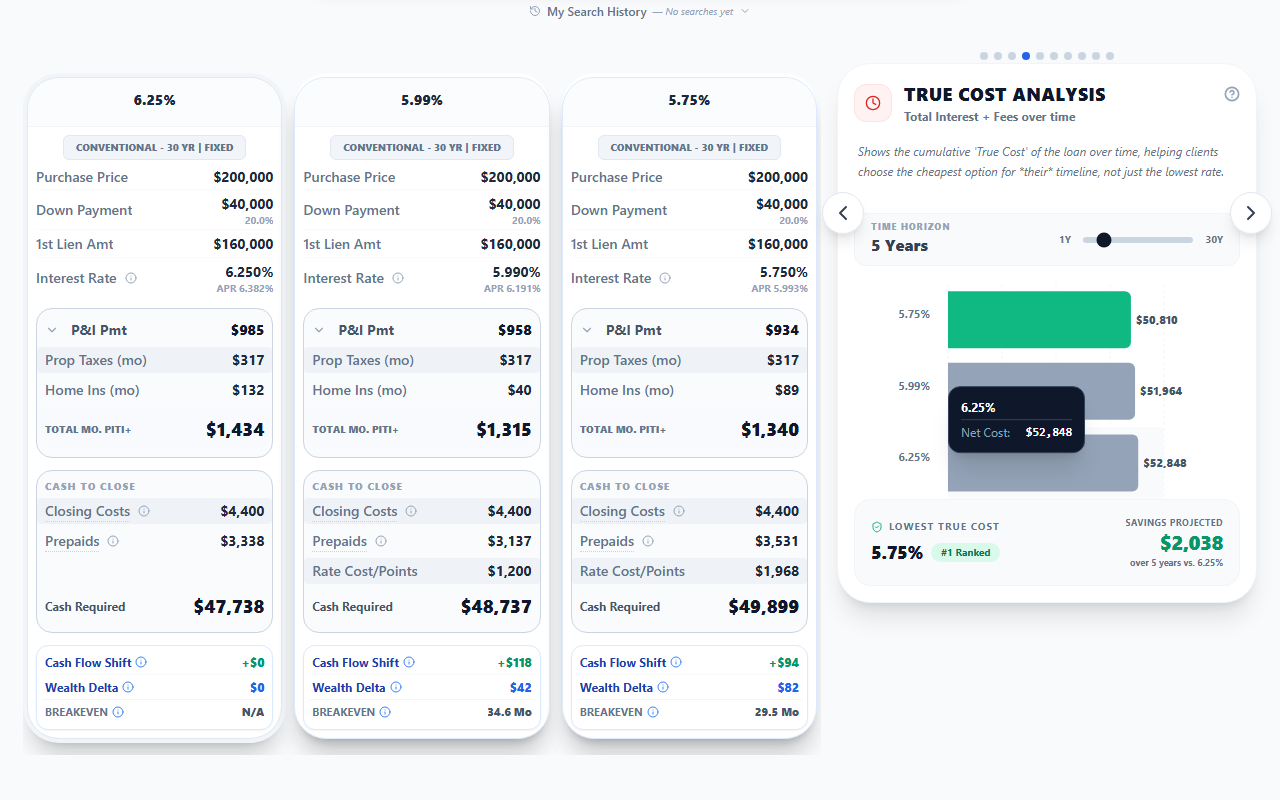
Cumulative cost of every option over the client's actual time horizon. Exposes the points-versus-credit decision the rate shopper got wrong.
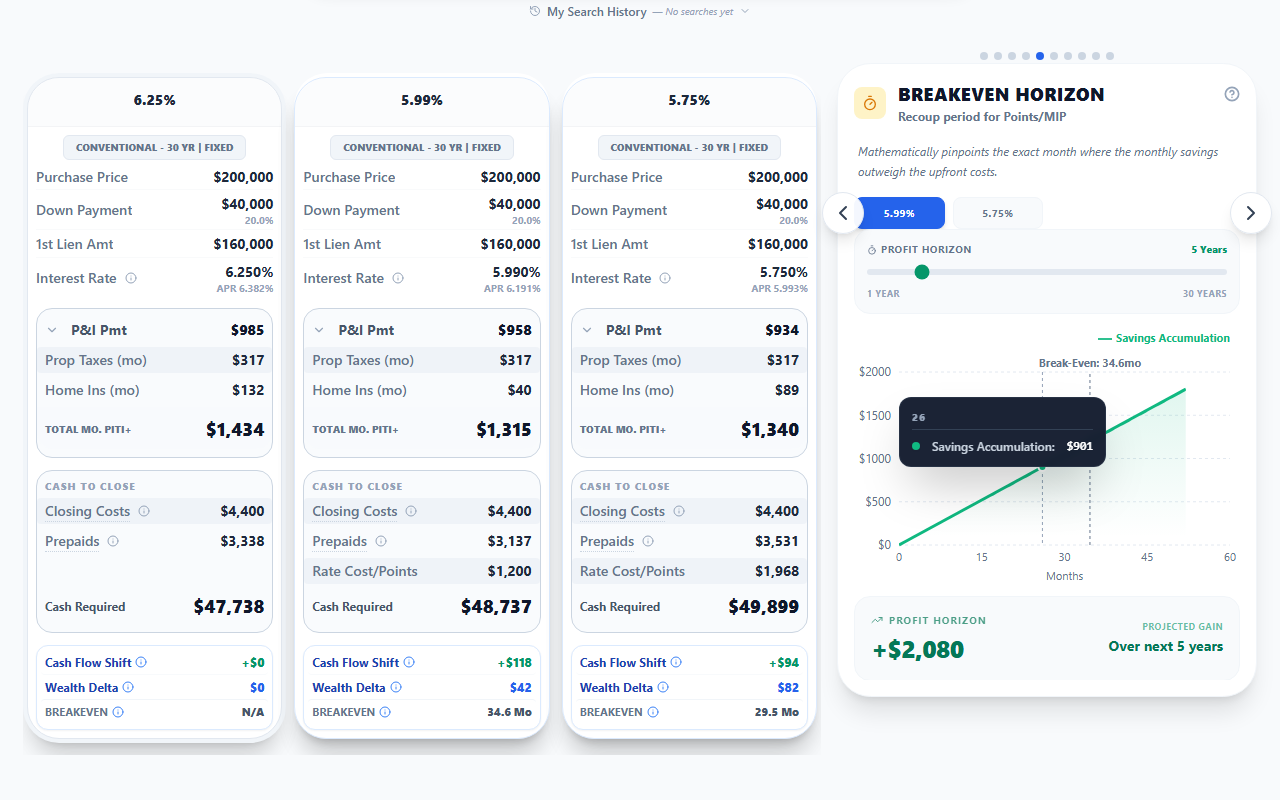
The exact month upfront cost pays for itself. Uses the Certified Mortgage Advisor True Breakeven formula, not the simple payment-savings shortcut.
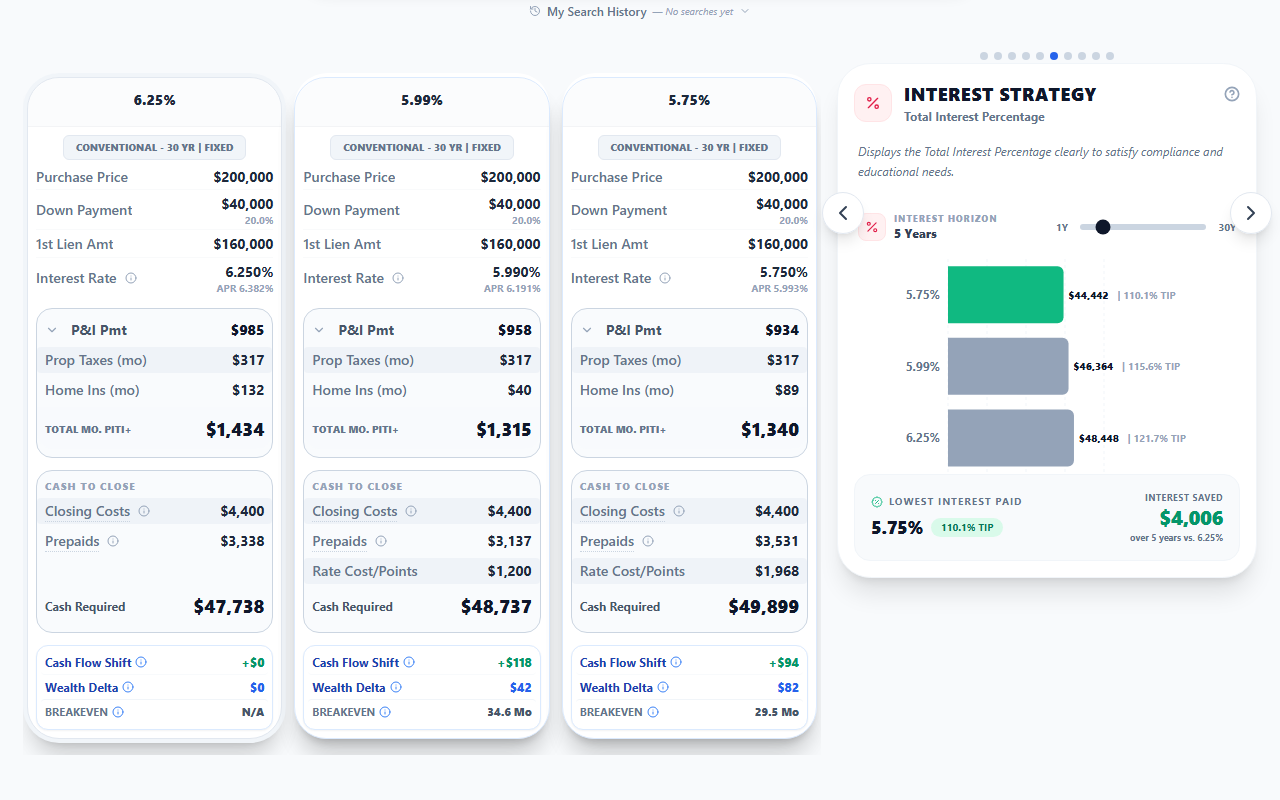
Total Interest Percentage. The ratio of total interest paid to loan amount. Makes the interest burden visceral instead of abstract.
The nominal rate adjusted for inflation. Shows the rate-fearful client that fixed-rate debt is an inflation hedge, not a tax.
Cash reserves prevent foreclosure. Equity does not. Compares 20% down to a smaller down payment with the difference held liquid.
30-year plus invested difference versus 15-year. Often shows the longer term builds more total net worth over a decade.
Down payment, points, or invested capital. Side-by-side comparison of where the next dollar should go.
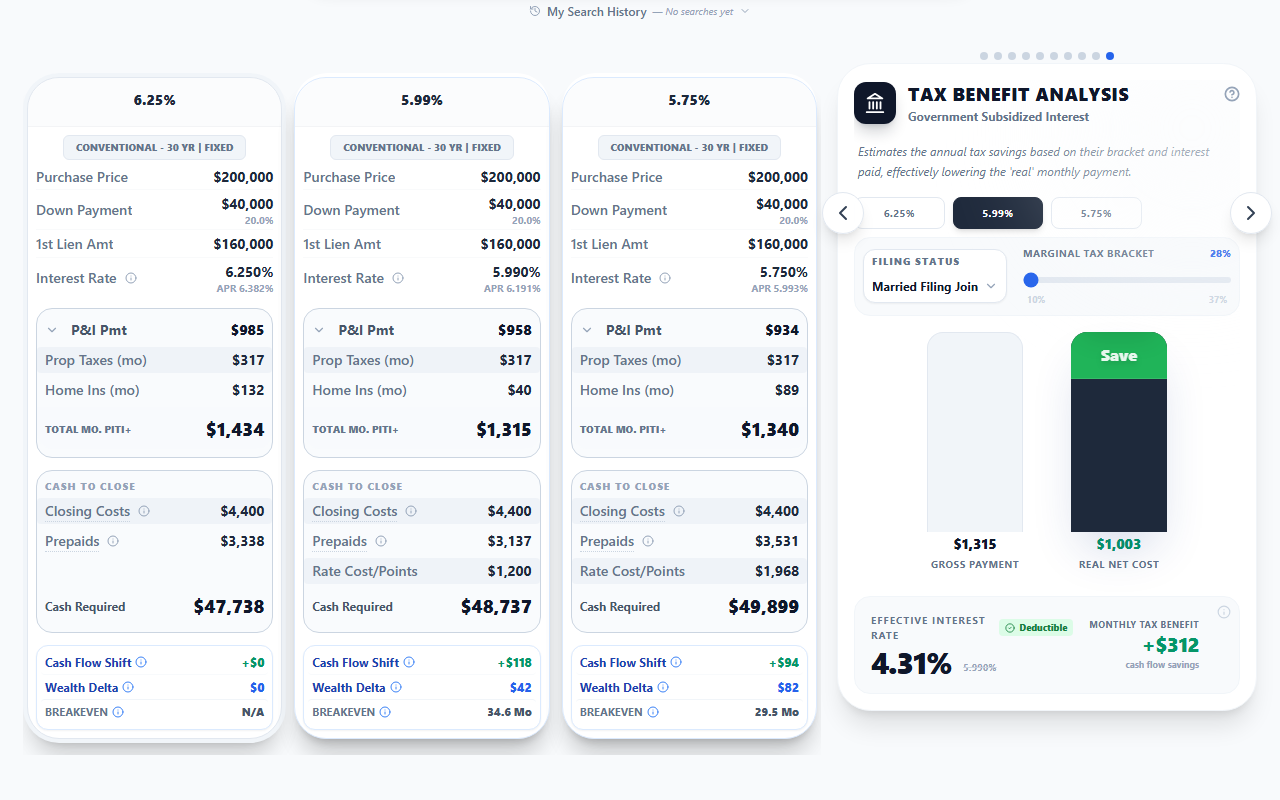
Effective after-tax housing cost. Quantifies the deductibility of mortgage interest and property tax for the high-bracket client.
What annual bonus payments do to the amortization curve. Visualizes years and interest dollars saved by extra principal.
Pay down the mortgage or invest the extra cash flow. Models total net worth under both strategies over the client's timeline.
How much the home needs to appreciate to cover an over-asking offer. Often a smaller hurdle than the client fears.
Lost appreciation versus rate savings. While the client waits for a 1% rate drop, prices may rise 5%. The math says buy now and refi later.
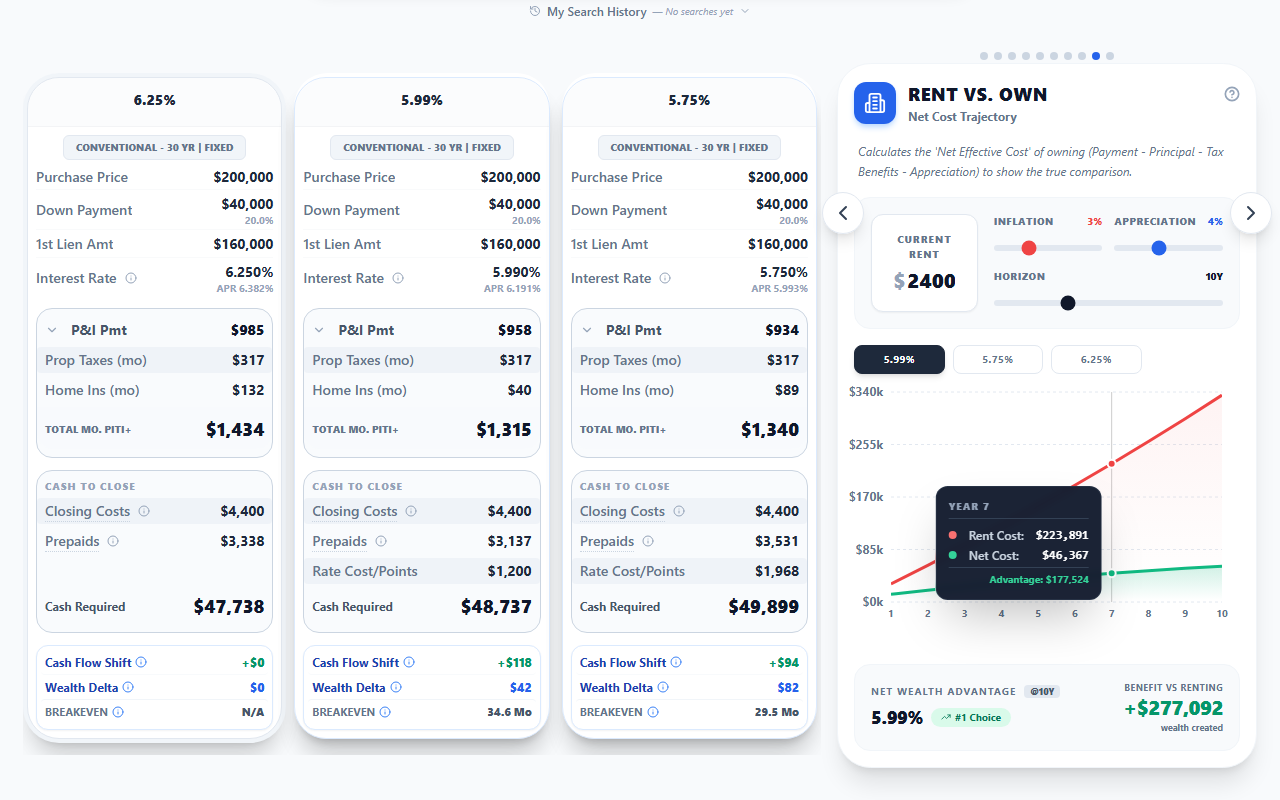
Net effective cost of ownership after principal, tax benefits, and appreciation. Often shows renting as the more expensive option.
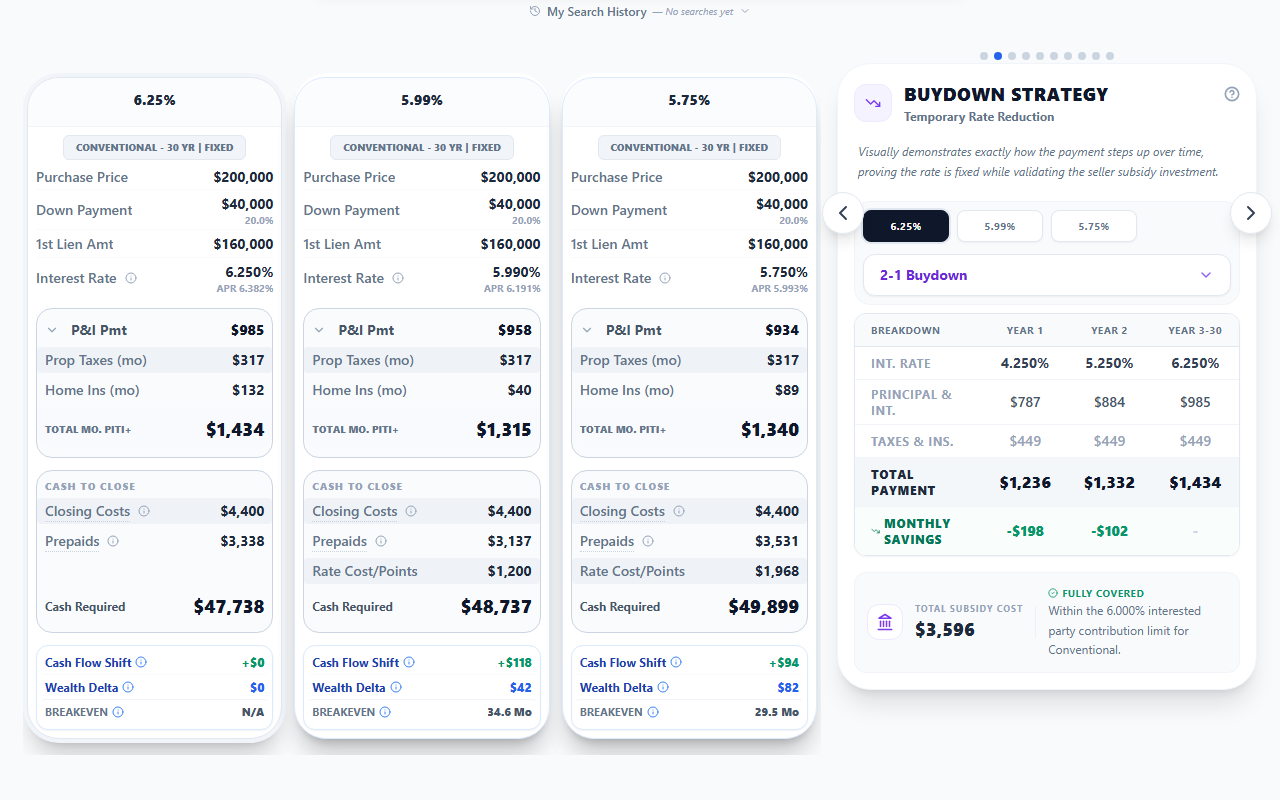
A 2-1 buydown is not an ARM. Visualizes how the seller's subsidy steps the payment up over two years while the rate stays fixed.
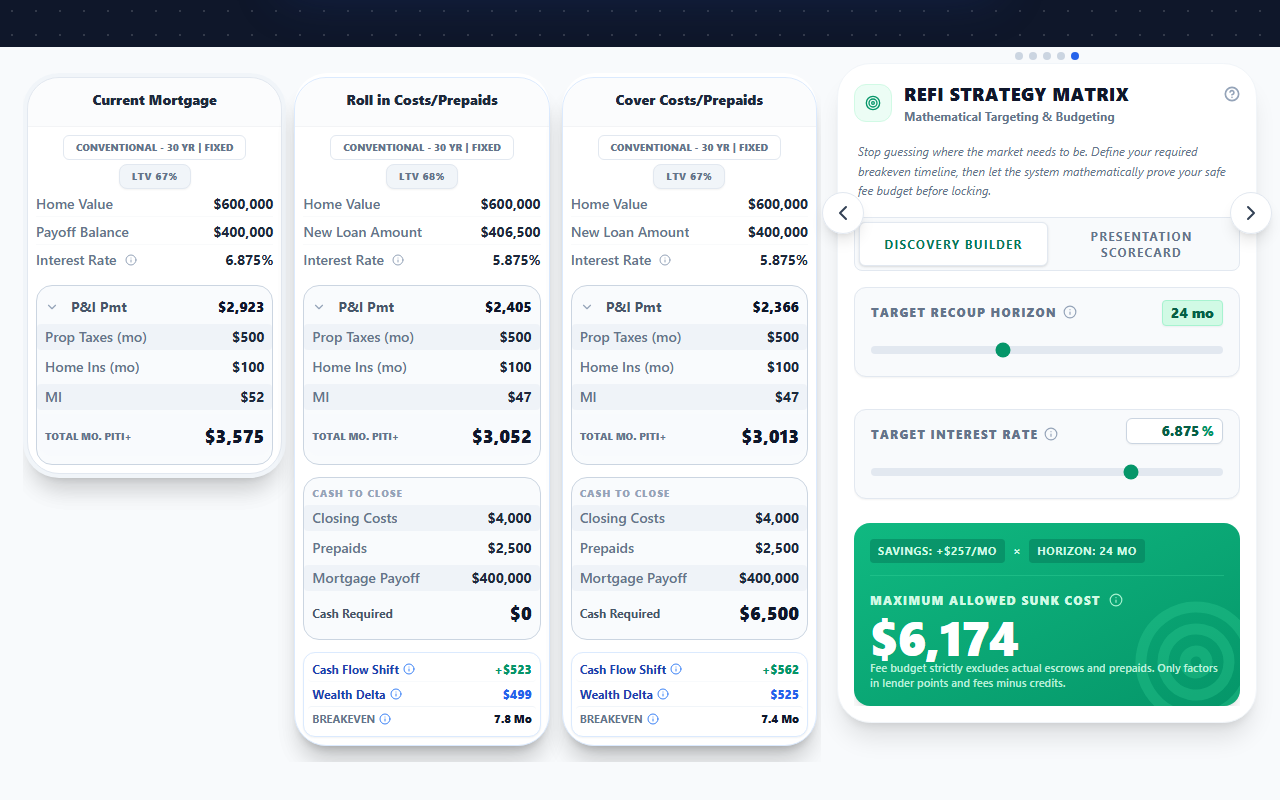
Inverts the refi process. Discovery Mode calculates the exact fee budget for a target recoup horizon. Presentation Mode auto-grades every live scenario.
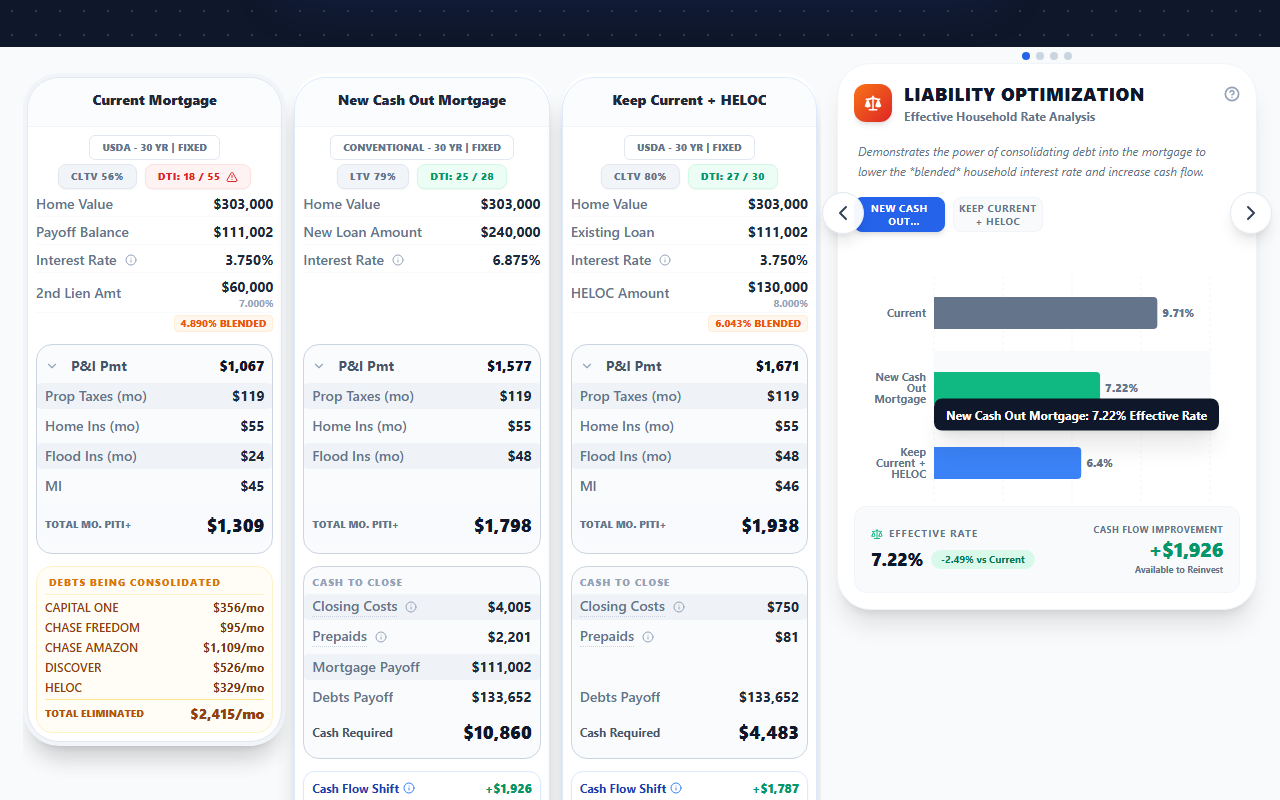
The blended household rate. Mortgage at 7% plus 22% credit card debt rolls up into a 14% household borrowing cost. Consolidation lowers the average.
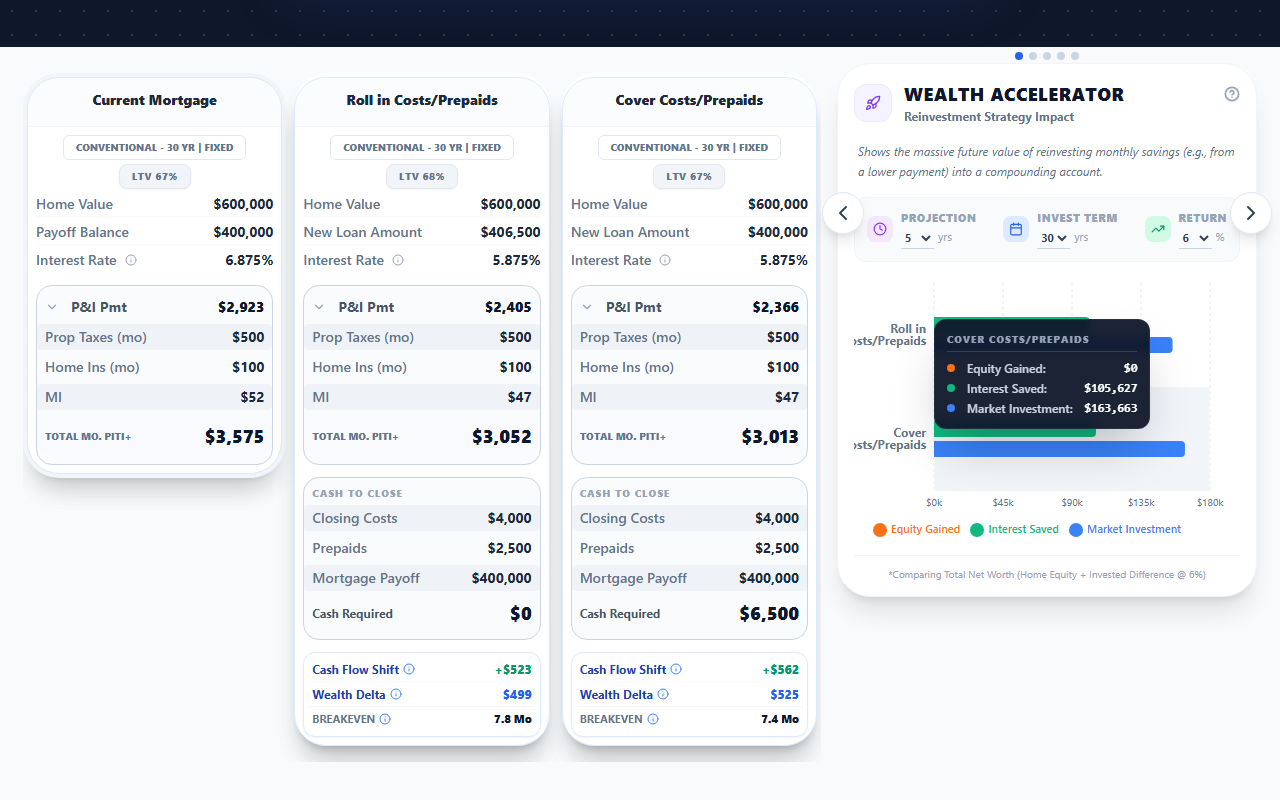
Refinance savings redirected at the principal. Pays the loan off years earlier. Compounds the interest savings into a future-value chart.
Forgone monthly savings while the client waits for another rate drop. Often takes years to earn back what they lost by waiting six months.
Reserve a seat in the next founding cohort. We onboard small batches so each advisor gets walked through their first strategy personally.
Join the Waiting ListOne pipeline. Six stages. Most advisors save ten minutes on every new file.
flowchart LR
U["Advisor or Client
types address"] --> PL["Property Lookup
RentCast + Vertex AI"]
PL --> SC["Scenario Card
price, taxes, HOA, insurance"]
SC --> AM["19 Analysis Modules
recalculate live"]
AM --> CP["Live Client Portal
shareable, branded"]
CP --> CC["Client-Chat
answers questions 24/7"]
CC --> AD["Advisor
engagement alerts"]
classDef stage fill:#1e293b,stroke:#3b82f6,color:#e2e8f0
class U,PL,SC,AM,CP,CC,AD stage
Source: PROPERTY_LOOKUP_FLOW.md §2. Cache TTL 7 days. PII never leaves the browser.
You do not need to read this to use the platform. We publish it because the loan officers who care about this kind of thing tend to be the ones we want to work with.
Every model swap on the platform is graded against the model it replaced. We collect a fixed set of historical inputs, run both models on every input, and have a judge model score the outputs head-to-head. We only ship a swap if the new model wins by a margin we can defend.
Four major migrations shipped this quarter. Architect to Sonnet 4.6 won at 88%. LensGuide to Haiku 4.5 won at 90% with a 99% prompt cache hit. Co-Pilot to Haiku 4.5 won at 90% at three times lower cost than the Sonnet baseline. Client-Chat to Haiku 4.5 won at 75%.
The grading harness lives in scripts/eval-*.mjs. The judge prompt is checked
into the repo. Eval results live in docs/EVAL_*.md for every migration.
We use the right model for the right job. No single-model lock-in.
Financial math is never AI. The calculation engine is pure TypeScript and is the same code path every chart on the platform reads from. AI explains the data. AI never calculates it.
When the Architect commits a strategy, it writes an eight-to-ten sentence case file: client profile, emotional state, top objections, the reasoning behind each module choice, coaching notes for the advisor, and data quality flags for any field that was estimated rather than verified.
The dossier persists in a Postgres table named shared_agent_context.
Co-Pilot reads it on every turn. Client-Chat reads it on every turn. The result is that
the same client story flows through the platform without the advisor having to repeat it.
When LensGuide tells the advisor to click a button, it does not just say "click the button."
It emits a named marker (something like lens:openSandbox, wrapped in double
curly braces). The frontend resolves that marker against a registry of named UI elements,
finds the live DOM element with the matching data-lens-id, and pulses it blue.
The registry has 36 entries. A build-time validator checks the registry against the
vocabulary in the LensGuide system prompt against the actual data-lens-id
attributes in the JSX. Drift gets caught in CI, not in production.
MISMO 3.4 XML files are parsed entirely in the browser using the native DOMParser. Raw files never touch a server, never reach AWS, never feed into a model.
Every AI prompt passes through a PII whitewashing layer that redacts SSNs, dates of birth, and street addresses before the prompt leaves the edge function. Every AI response is audit-logged. AI partners are configured for zero retention.
Reserve a seat in the next founding cohort. We onboard advisors in small batches so the first strategy you build is walked through with you.
Last call to reserve your spot.
Join the Waiting List